Back to Games
Signal Grid

Signal Grid

Puzzle Mobile Friendly

About Signal Grid

Rotate circuit nodes, route power from the source, and light every target on the board. Signal Grid is a portrait-first logic puzzle built for short browser sessions on phone or desktop: every tap rotates one tile, every rotation changes the live power flow, and every board can be understood in a glance but rarely solved without a few deliberate corrections. The puzzle generator creates deterministic seeded boards, which means the daily puzzle is the same for every player on that day while Quick Play keeps serving fresh layouts. Some boards reward a direct route. Others ask you to repair the backbone first, then branch outward into the side targets. The challenge is not speed tapping; it is reading the network, recognizing which connection is blocking power, and fixing the board in as few moves as possible.

How to Play Signal Grid

Controls

  • Rotate a node: Tap a tile on mobile or click it on desktop.
  • Choose mode: Start the shared Daily Puzzle or generate a fresh Quick Play board.
  • Mobile command rail: Use the touch buttons under the board to pause, restart, or enter fullscreen.
  • Pause on desktop: Press P or Esc.
  • Restart on desktop: Press R.
  • Next board: Press Enter after solving.
  • Fullscreen on desktop: Press F.

Objective

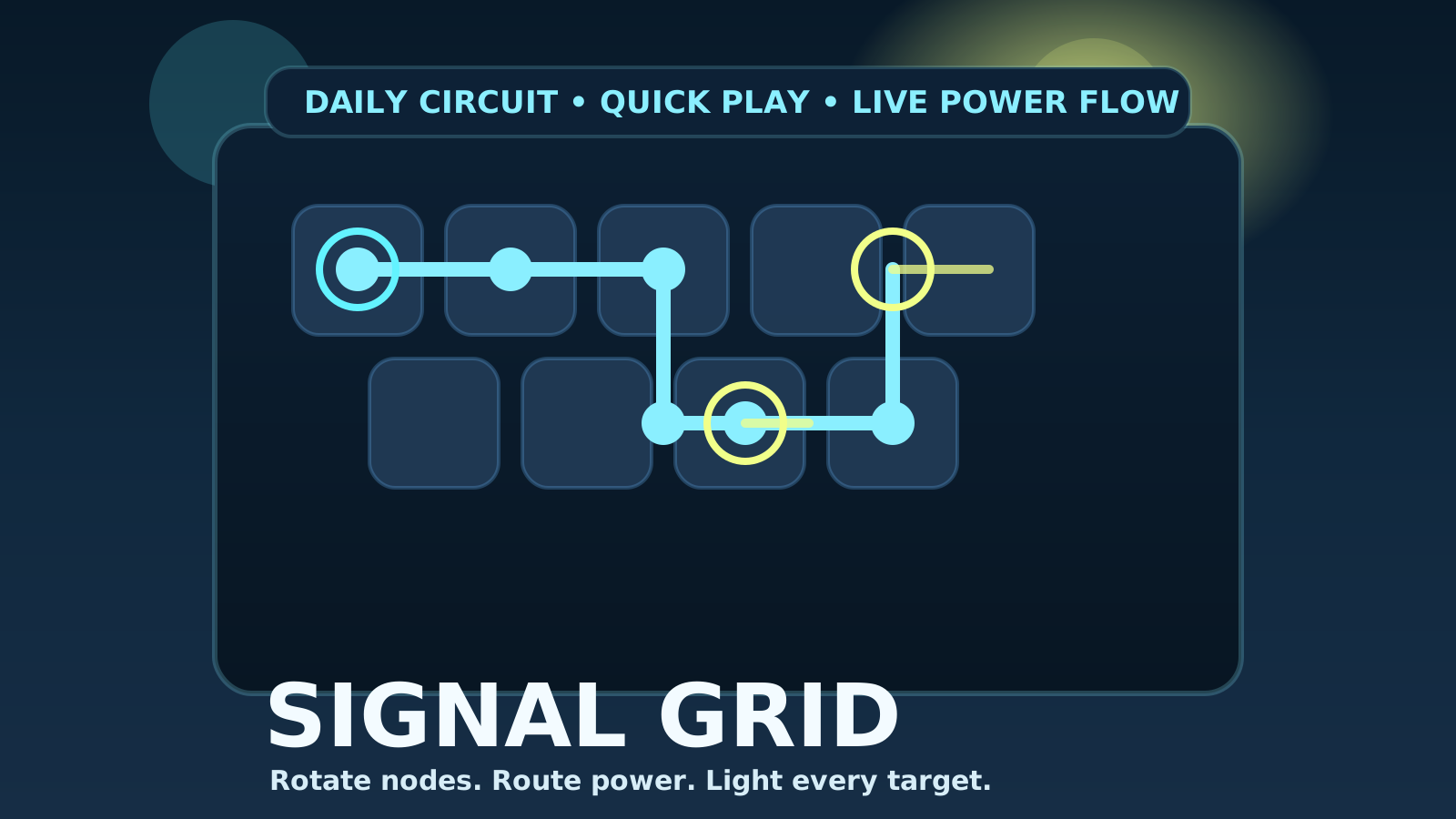
  • Route power from the cyan source node to every yellow target node.
  • Rotate as few tiles as possible — lower move counts produce stronger ratings.
  • Watch the live power flow after every move; lit paths tell you what is already correct.

How To Read The Board

  • Cyan node: The power source. Everything starts here.
  • Yellow rings: Target nodes that must be energized to solve the puzzle.
  • Blue links: Regular wire nodes that carry the signal between source and targets.
  • Dark cells: Empty space. They do not rotate and do not carry power.

Tips & Strategy

  • Fix the trunk before the branches. If the main line out of the source is broken, side targets do not matter yet.
  • Use live power as feedback. The moment a section lights up, you know the chain behind it is correct and can focus farther ahead.
  • Dead-end nodes are clues. A single-connection tile usually points toward the only place it can belong, especially near the board edge.
  • Straight pieces are easy to over-rotate mentally. Check whether they should be horizontal or vertical before spending moves elsewhere.
  • Do not chase every target at once. Solving one clear route completely is usually better than half-fixing three separate branches.
  • Daily puzzles reward clean solves. The board is shared, so a strong move count matters more than frantic tapping.

The Story Behind Signal Grid

Signal Grid was designed to fill a different niche than most of the YoyoArena catalog. Many games on the site are about tempo, reflex, or surviving pressure in real time. We wanted one game where the player could stop, look, think, and still feel momentum. A live circuit puzzle solved that. The board updates immediately after every move, which means the game never feels static even though it is entirely turnless and deterministic. A good logic puzzle should feel like a conversation with the board: you make a change, the circuit answers back instantly, and that answer tells you what to do next.

The daily-seed structure arrived early because this genre benefits from shared boards. When everyone sees the same puzzle on the same day, move count becomes meaningful in a way that random solo boards cannot reproduce. Quick Play still matters for warmup and endless play, but the daily board gives the game a reason to come back tomorrow. That retention pattern is closer to newspaper-style logic games than to arcade score attack, which is exactly why it fits the catalog as a counterweight to action-heavy games.

We kept the first version deliberately narrow. There are no color channels, locked nodes, or one-way gates yet. Those mechanics can be good, but they also risk burying the elegant part of the puzzle under too many exceptions. The core of Signal Grid is rotate, read, correct, and route. If that loop is strong, the game stands on its own. If it were weak, extra mechanics would only hide the problem for a while. The current build stays focused on the circuit-reading skill and lets the seeded boards provide the variety.

Frequently Asked Questions

What is the difference between Daily Puzzle and Quick Play?
Daily Puzzle uses one deterministic board shared by every player for that date. Quick Play generates a fresh seeded board so you can keep playing beyond the daily challenge.
Can I play Signal Grid on mobile?
Yes. The game is designed for portrait touch screens first. Tap any tile to rotate it, then use the touch command rail under the board if you want to pause, restart, or go fullscreen without a keyboard.
How do I know if I am making progress?
Powered links light up in real time. If more of the network glows after a rotation, you repaired part of the circuit correctly. The targets counter at the top tracks how many destination nodes are currently online.
Is Signal Grid timed?
You are not forced by a countdown, but your move count and solve speed both affect the final rating. Efficient solves score better than messy ones.
Can a board be impossible?
No. Boards are generated from a valid solved network first and then scrambled, so every puzzle has at least one correct arrangement.
Does Signal Grid save my best result?
Yes. The best score for Daily and Quick modes is stored locally in your browser so you can track improvement on the same device.
Is Signal Grid free?
Yes. Signal Grid is free to play in your browser with no install and no unlock gate.

Tags

Puzzle Logic Daily Puzzle Circuit Rotate Brain Teaser Mobile Puzzle Grid