
Signal Grid
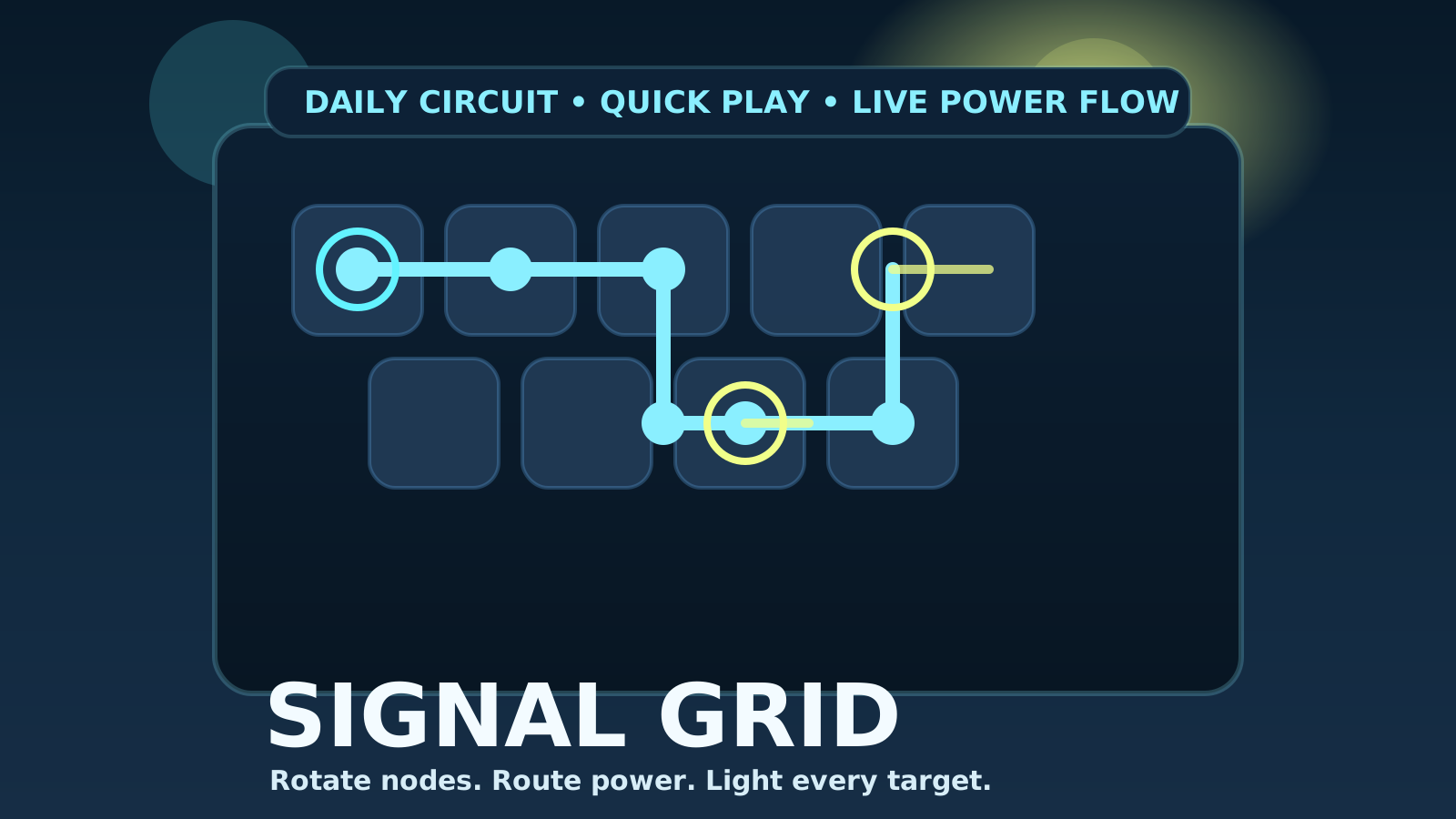
Rotate circuit nodes, route power from the source, and light every target on the board. Signal...

Draw the path, solve the physics. Gravity Rush is a puzzle game where every line you sketch becomes a real physical surface — and a rolling ball must cross it to reach the glowing goal. Each level hands you a small number of strokes and asks you to plan a route through obstacles using angle, length, and placement. Short lines redirect; long lines cradle; angled lines convert falling momentum into horizontal motion. The puzzles are not about finding one right answer — they are about finding your answer from among many, under a stroke budget that forces creativity. Star ratings reward elegant solutions, and later levels chain multiple physics ideas into challenges that feel earned when you solve them. The game ships with 50 levels in five difficulty tiers, from tutorial puzzles to master-level challenges.
Gravity Rush started with a deliberately awkward question: what would a physics puzzle look like if the player had to draw the puzzle, not just solve it? Most physics puzzles hand you a fixed toolbox; we wanted to see what happened when the toolbox was literally a pen. The first prototype had unlimited strokes, which was actively bad: with no limit, a player could draw walls, box the ball in, and reach the goal in seconds.
The stroke budget fixed it. Limiting strokes per level forced real thought into every line, and it created the secondary game of finding more elegant solutions. Three-star runs almost always use fewer strokes than a bare-pass run, so the game quietly rewards reconsidering each line rather than just any line that works. Passing a level is enough to move on, but the star rating and lines-used count on the results screen leave room to retry and find a cleaner solution.
Line physics sit on top of Three.js plus a small custom physics solver. Early builds had line collisions snapping to a pixel grid, which caused visible jitter on slow-moving balls. The current build interpolates collision surfaces across subframes, which costs a bit of CPU but eliminates the drift. Related intuitive-input physics work runs through Rope Snip — different inputs, same tension between an intuitive gesture and a precise simulation underneath.
Rotate circuit nodes, route power from the source, and light every target on the board. Signal...

Swap neon gems, clear matches of three or more, and chain cascading combos across a glowing...

Cut ropes, drop candy, feed Chompy. Rope Snip is a physics puzzle game built on the elegant...